

Welcome Remarks by Deputy Minister of Foreign Affairs and International Trade of Armenia at the Subregional Capacity Building Workshop on Advancing Sustainable Transport Corridors to Strengthen Inter- and Intra-regional Connectivity
14 September, 2026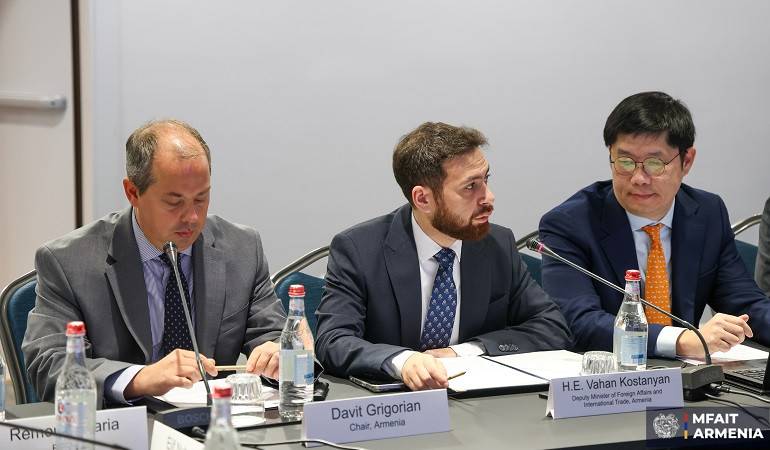
Excellences,
Distinguished Delegates,
Dear Colleagues,
Ladies and Gentlemen,
It is my utmost pleasure to welcome you to Yerevan at the Subregional Capacity Building Workshop on Advancing Sustainable Transport Corridors to Strengthen Inter- and Intra-Regional Connectivity.
I would like to start by thanking the UN ESCAP for co-organizing this important event and its continued engagement in supporting landlocked developing countries through facilitating regional dialogue on transport connectivity. The Awaza Programme of Action for Landlocked Developing Countries, is the blueprint for renewed international efforts to address the structural challenges faced by LLDCs. Active engagement of the UN Regional Commissions will be indispensable for ensuring its implementation through cross-regional cooperation and sharing of best practices.
Ladies and Gentlemen,
Efficient connectivity is a crucial element of Armenia’s geographical and economic reality. Situated at the crossroads of different regions, Armenia has historically served as a bridge between neighboring countries and a wider region stretched across the ancient Silk Road. Today, we see connectivity as an essential component of sustainable development, economic resilience, competitiveness, regional cooperation and intercultural exchanges.
This is why we consider the theme of our workshop as particularly timely.
The recent studies show that transport routes must be able to withstand disruptions and provide predictable services for businesses and communities. In the meantime, development of new transport routes creates opportunities to ensure sustainable supply chains, diversify trade, strengthen regional economic integration and connect previously less accessible markets.
For Armenia, these objectives are closely linked to our broader vision of strengthening regional connectivity and unlocking the potential of our transport network. We are focused on improving transport infrastructure, modernizing border-crossing facilities, enhancing logistical capabilities and strengthening good governance that can make the movement of goods and people more efficient and reliable.
However, we also recognize that no transport route can be truly effective if connectivity faces challenges at national borders. That is why we actively look beyond physical infrastructure and attach particular importance to border-crossing facilitation, harmonization of documents, streamlined procedures, effective information exchange, greater use of digital technologies, and other components of the concept of the so-called “operational connectivity”, that can reduce administrative burdens, increase transparency and improve the predictability of cross-border transport.
For us, these are not merely technological improvements. They can directly contribute to reducing the cost of trade and improving access to international markets. We therefore very much commend the opportunity provided by this workshop to consider sustainable transport connectivity in a comprehensive manner.
Distinguished Guests,
The participation of countries from across the wider connectivity landscape in today’s Workshop - including China, Russia and Türkiye - is especially valuable, as the success of transport connectivity depends on cooperation among all countries along the route.
In this regard, I would like to emphasize the importance Armenia attaches to regional cooperation and dialogue.
We believe that connectivity should serve as an instrument for bringing economies closer together. It should create opportunities for trade, investment, tourism and people-to-people contacts, while contributing to economic diversification and resilience.
We see our national connectivity priorities as part of a broader regional picture. Our efforts to improve transport infrastructure, facilitate cross-border movement and strengthen logistics can create greater value when they are integrated into wider regional networks.
The centerpiece of our efforts is the “Crossroads of Peace” initiative, with its integral part – the TRIPP, which aims at contributing to intra-regional and global trade by establishing trade and transport connectivity in the South Caucasus and significantly transform the region's transport and logistics infrastructure, by integrating into various international routes, thus offering reliable alternatives to reduce the time and costs of cargo transportation.
The TRIPP is intended to establish unimpeded, multimodal transit connectivity on the territory of Armenia, contributing to regional peace, stability and prosperity on the basis of respect for sovereignty, territorial integrity, and jurisdiction of the Republic of Armenia. It will generate reciprocal benefits for international and intra-state connectivity for the Republic of Armenia through the territory of Azerbaijan.
In other words, TRIPP is a comprehensive framework, which not only outlines the modalities of trade and transit freight in the region, but also lays the groundwork for stronger integration of South Caucasus into global supply chains. By signing of the Framework Agreement between Armenia and the United States on Strategic Cooperation concerning the TRIPP in June this year, the project entered into the practical implementation phase.
Distinguished Colleagues,
The success of a transport route is measured not only in length of roads or infrastructure investments made, but also whether goods can move quickly and predictably, whether businesses can reach new markets, and whether countries can become more resilient and better integrated.
I am confident that the expertise and experience represented in this room will allow us to have a substantive and forward-looking discussion. I also hope that this workshop will strengthen our professional networks and generate practical ideas that can be translated into concrete cooperation at the national, sub-regional and regional levels.
Once again, I am pleased to extend a warm welcome to all distinguished participants, representatives of governments, international organizations, international financial institutions, experts and colleagues who have joined us for this important discussion.
I wish you productive discussions, an open exchange and, most importantly, tangible outcomes that will contribute to stronger, more sustainable and more resilient transport connectivity across our region.
I hope you will also have an opportunity during your stay to enjoy Yerevan, experience our hospitality and to discover a small part of our country’s rich history and culture.
Thank you.