

The Interview of Foreign Minister of Armenia Ararat Mirzoyan to Deutsche Welle
30 September, 2025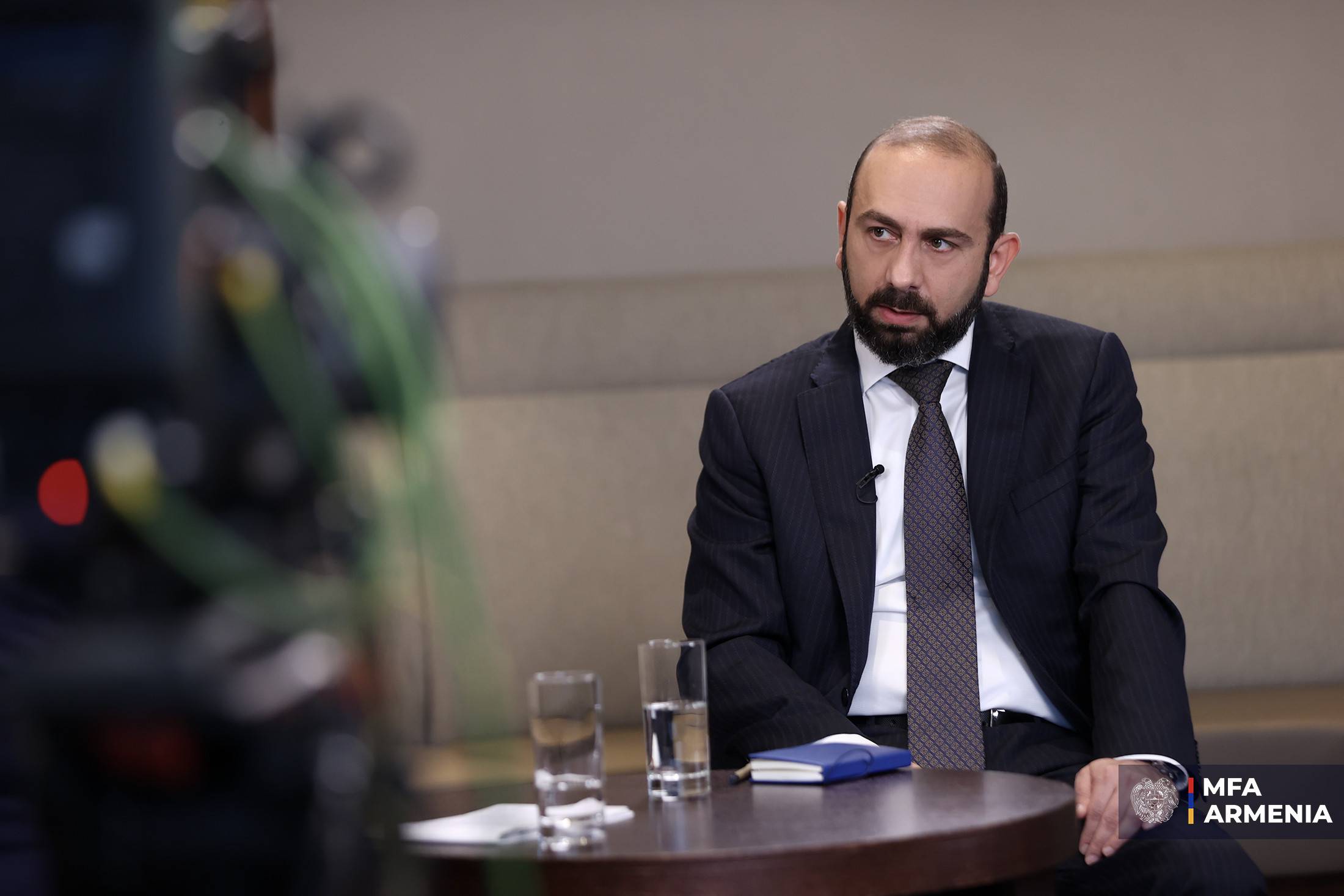
On the margins of the Warsaw Security Forum, Minister Mirzoyan gave an interview to Deutsche Welle.
Journalist: Minister Ararat Mirzoyan, welcome to Deutsche Welle.
Ararat Mirzoyan: Thank you for the invitation.
Journalist: Let's start with the initialing of what could be, I think, broadly called the Armenia-Azerbaijan peace process. It was in August in Washington. So, how do the next steps look, looking from Yerevan?
Ararat Mirzoyan: Well, first of all, on the 8th of August this year, we had the trilateral summit with thе participation of Prime Minister of the Republic of Armenia, President of Azerbaijan and also President Trump of the United States in the White House, by mediation, or call it facilitation or witnessing by President Trump.
So, first of all, a declaration was signed by three leaders. And in this declaration, they welcomed the initialing of the Peace Agreement, which was initialed by the foreign ministers.
They agreed upon several fundamental principles, like time and again, reciprocal acknowledgment of territorial integrity, inviolability of borders, and also the leaders agreed over the long-negotiated connectivity issue. So, you know that unblocking the transport communications, this transit infrastructure is being discussed between Armenia and Azerbaijan.
So, in this declaration, they agreed upon the main fundamental principles under which or in the frames of which this unblocking should take place. This is crucial. This is very important.
One of the most important aspects of the whole negotiation process and the deal. And here as well, they acknowledged that the infrastructure which is going to be unblocked should remain under or be operated according to territorial integrity, inviolability of the borders, and also sovereignty, which is very important, national jurisdiction of the countries, which means that the infrastructure on the Armenian soil, Armenian territory, should function according or under our national jurisdiction and respectively the Azerbaijani infrastructure. This sounds natural, but we have been negotiating on this very simple, but principal issue for months and years. And also, the arrangements should be reciprocal. So, this is a very important accomplishment, quite a milestone.
And as I said, we also initialed the peace treaty. Again, a very important text, which was agreed in March, but all the efforts to somehow sign it, initial it, were in vain. So, in August, we did it. Next step, you're asking, next step is naturally two things. Signing the Peace Treaty, which was initialed, and also already agreeing on the concrete technical modalities, technical solutions of this connectivity issue, and then start constructions, etc, But in parallel, there are also ongoing processes, which take place on the ground.
Like we have started the delimitation of the interstate border between Armenia and Azerbaijan. We have already delimited 12 kilometers of our border. This is an unprecedented thing. We also have a mutual understanding of how this process should continue.
We agreed upon principles. We even signed the regulation of the joint work of two state border Commissions, and it was ratified. So, it is happening.
Journalist: So, what is, to give it a rough sort of outline, what is the time frame for all that? Because establishing, delimiting all borders, basically signing the peace treaty, establishing official diplomatic relations and embassies, and so forth, it takes time. On the other hand, all these things are sort of interconnected. So, what do you think is the time frame?
Ararat Mirzoyan: Indeed, everything is interconnected. But also, I should state that it's not easy. If it were easy, it would have been done long ago. So, I suppose that the delimitation will continue at the same pace. Maybe the works could be even intensified. As for connectivity, we should, as I said, agree upon the modalities. But we, here I mean Armenia and the United States, because we agreed that the part which should be constructed and then functioned on Armenia’s territory, maintained by a consortium, an American-Armenian consortium, a company, which can hire another, a third company, for instance, to implement the daily duties. So, for connectivity, the next step is agreeing upon these modalities and then starting the construction of the missing part of the railways, for instance. It can also be a pipeline, and we should start the work from zero.
For the peace treaty, the next step is the signing. But here, there is a nuance. The Azerbaijani side, unfortunately, makes a precondition for signing the peace treaty. They think, and we don't share this, we have counterarguments, it is their narrative that there is a problem in our Constitution. So, they want us to amend the Constitution. This is their condition, which we don't agree to. We have an agenda of amending the Constitution or adopting a new constitution.
Journalist: Armenian lands outside of the accepted borders, right? Let's say, Karabakh and so forth, right?
Ararat Mirzoyan: ….that is what is behind this story.
But there is nothing in the Armenian constitution showing that there is any territorial claim against Azerbaijan. I can elaborate on this a little bit more, if you want. So, we do have in our constitution a reference to our Declaration of Independence. But it is like: “Based upon the Declaration of Independence” and then the main body of the Constitution. So, according to our legislation, only those provisions of any legal act or declaration of independence have imperative legal force, only those that are literally quoted in the constitution. So, we don't have any quotation. There is no problem. Nevertheless, the Azerbaijani side sees and brings this condition. We don't agree on this condition. But as I said, we have been speaking about amending or adopting a new constitution in Armenia since 2018, I believe. So, it is on our agenda.
There is a commission. This commission was established long before the war, long before the negotiations or agreements. So, this commission is already finalizing its work. And we are going to have, most probably, a referendum on this. But it will take place after the parliamentary elections that we are going to have next summer. So, I am saying this to show that there are steps that we will be implementing in the near future, coming days, coming months, there are steps that can take place later.
Journalist: But if you count the elections and things like that, we are talking about years, right? At least a few years before the whole thing is more or less done.
Ararat Mirzoyan: Maybe a couple of years. But this is also important to state. We, the Armenian side, are ready to sign the peace treaty immediately. The text is agreed. The text is initialed. We don't see any problem. We can sign it tomorrow.
Journalist: Coming back to the so-called Trump...
Ararat Mirzoyan: Trump Route for International Peace and Prosperity.
Journalist: As far as I understand, you already started discussions with the U.S. side on that. You said that there is going to be a consortium that is going to build it. Who is going to manage it eventually? Territorially, the corridor is going to go through the Armenian territory to Nakhchivan, to Azerbaijan. It's a politically sensitive issue. So how is it going to be managed and operated, in your view, as you see it now?
Ararat Mirzoyan: Well, first of all, it's not a corridor! I know, I understand that saying a transport corridor does not leave any negative impression. These days, everybody is in search of new logistic routes, etc. But it's not a corridor.
And why am I saying this? We had an impression, we had a belief that during the whole months and years of negotiations, the Azerbaijani side was trying to attach some signs, some attributes of an extraterritorial corridor to this passage. For instance, they have been demanding to bring and deploy, for instance, third-party forces along this railway. I remember they have been speaking about the necessity of Russian troops to be deployed along the railway, which was unacceptable, of course, for us.
And now there is no corridor. I mean, there is TRIPP, which is the Trump Route for International Peace and Prosperity. And all the attributes of sovereignty and our national jurisdiction are acknowledged by Azerbaijan, also by the United States, over the territory, over the passage, over the infrastructure.
So we don't have any extraterritorial corridor on our territory. It is also important to know that we don't speak about only this passage, only connecting the main part of Azerbaijan with the Nakhijevan Autonomous Republic. We speak about, and this is the agreement, to unblock all the transport communications, all the infrastructure between the two countries.
So we get access to the Azerbaijani railway, the whole system, the whole chain. Azerbaijan gets access to our railway. Լike usual, ordinary neighbors you can pass through each other's territory. This is what's going to take place, and this is what is agreed. This should be governed, managed by an Armenian-American consortium, which, of course, can hire subcontractors to deliver separate duties, services, etc. And those third companies should be selected by mutual consent.
Journalist: Doesn't look like they're going to be Russian companies.
Ararat Mirzoyan: Why do you say so?
Journalist: Because we're going to have a question about Russia.
Ararat Mirzoyan: No, a company that can be potentially selected should be approved by Armenia and America. We're open for cooperation with many countries. I'm not excluding anyone, but there are certain countries candidacies of which can be potentially rejected.
Journalist: Turkey. It looks very close. It is an important player in the region. If I understand correctly, the Armenian side is pretty much ready also to open communications across the border with Turkey. Looking at the media, at least, it doesn't look like the Turkish side has made as many preparations as the Armenian side. What are your conversations now with the Turks? I mean, the border infrastructure seems to be very different on the Armenian side. It's pretty much ready, on the Turkish side, not so much.
Ararat Mirzoyan: That's partially true, because we do have very good dialogue with Turkey on many levels, starting from leaders, foreign ministers, special envoys, even technical teams. I'm not even speaking about ministries, different ministries, etc.
So, the whole dialogue has been taking place, and now is currently taking place, without any preconditions. Saying so, our Turkish counterparts at the same time outlined that they can't finalize the process and open the borders and establish diplomatic relations before Armenian-Azerbaijani normalization. Now it's done.
I mean, the Armenian-Azerbaijani peace agreement is initialed. There is no argument about the text. I personally don't see any problem for the opening of the Armenian-Turkish border, Armenian-Turkish diplomatic relations, etc.
This, also, you know, has been confirmed by our Turkish counterparts as well. They show, they express, and then in reality they show readiness to open the borders, to have the Gyumri-Kars railway connection relaunched, to relaunch the bilateral direct trade, not even speaking about the establishment of diplomatic relations, etc. So, my opinion is that we will have very tangible progress in this regard in the coming weeks and months.
It's a matter of, I don't know, several months maximum. This is my perception; we will see.
Journalist: Let’s speak about the European Union. For the EU, in a sense, a new chapter has begun. The Armenian government is talking about the intention to maybe join the EU. Also, Armenia is one of the three sort of preferred partners within the EU-Eastern Partnership: Moldova and Ukraine, Armenia. I understand that there are issues, not so issues, but there is a desire to have visa-free agreements with the EU, like Georgia, Ukraine and Moldova have. A friend of mine who is a diplomat, Western diplomat, posted in Yerevan, said that Armenia is probably going to next year, in his view, submit an official request to join the EU and start the process. Is it true?
Ararat Mirzoyan: We have a law obliging the government of Armenia to have and implement a policy and to have as a goal the EU's accession. So, when we will be applying, I cannot be very sure, next month, next year. It's a matter depending on many factors. But, as I said, this is our official policy. Meanwhile, not waiting for this official application or response from the EU, we have already started with the European Union a significant deepening of bilateral relations.
We have a CEPA agreement, we have already started the visa liberalization process, and the impression is that this process is going quite well. We are negotiating over several new documents. We finalized the new Partnership agenda. It's going to be signed in the coming two, three maximum months. So, many things are happening between Armenia and the European Union and this is also interesting to note. We see a demand from citizens of Armenia to go even further. We see some criticism for possible delays and, I don't know, long procedures, internal procedures, etc.
Journalist: Do you think the visa-free arrangement, if it happens, will happen within a year, two years? How long will it take, give or take?
Ararat Mirzoyan: It's difficult to make such an assumption, but one could say that from one to two years is quite a realistic timeline.
Journalist: Now the big white elephant in the room is Russia. How is Moscow reacting to your future peace treaty with Azerbaijan, with overtures to the EU? They don't like it, no?
Ararat Mirzoyan: Maybe. I'm not excluding. Well, Russia is one of our main partners when it comes to trade and economy. We've been talking a couple of minutes earlier about some possible EU measures and instruments to ease access, for instance, for Armenian goods to EU markets. Now we are in the middle of diversifying our economic, trade, and energy contacts, let's put it in this way. So there have been many issues on which Armenia and Russia have agreed, there are still many issues on which Armenia and Russia do not agree.
So, in the case of this peace arrangement, the establishment of peace, and also the connectivity, in case of these issues, what we saw is the welcoming statement by official Moscow, and also we saw the readiness expressed by high Russian officials to support, to participate in the connectivity projects, etc.
Journalist: The Russian official sort of voices may be silent, but if you look at the Russian state TV, which is an instrument of the government, it's not very positive towards the peace treaty with Azerbaijan. It castigates both Azerbaijan and Armenia. You represent Armenia, as essentially, you know, turning your back on Russia. It's extremely intense propaganda. So it seems like they're expressing the view of the government that looked at you before as a country that's very tightly connected to Russia, and now not anymore. Do you feel in danger by this, looking at Ukraine, looking at the neighborhood?
Ararat Mirzoyan: Well indeed, when you look at the media, not only media, officials as well from time to time, members of the parliament, politicians, experts, so we see very often, very heavy “criticism” towards Armenia, criticism of the Armenian Government, Armenian democracy, Armenian sovereign decisions, even personalities, Armenian leaders. And of course, this deepens the misunderstanding or gap, one can say, or I don't know, disagreement between Armenia and Russia.
We have been drawing, kindly drawing the attention of our Russian colleagues to these media attacks or, I don't know, narrative or propaganda attacks against Armenia.
Journalist: What did they reply, the Russian colleagues?
Ararat Mirzoyan: Well, I don't think that the reply is satisfactory. As I said, those are our sovereign decisions. Democracy is our choice, deepening relations with the European Union, with the United States, with whom we are strategic partners now, with the others, is our sovereign choice, sovereign decision. So, either normal partners respect each other, including the decisions, or maybe that partnership needs some reforms, some refreshment.
Journalist: That's true if you talk about sovereignty and in the ideal world of international relations that should be so, but if you look at the connections that Armenia has, especially because it is a landlocked country, gas supplies from Russia going to Armenia, railway lines, a Russian air base, and the base in Gyumri. Russian influences in Armenia, there are, let's say, forces that say that the current government should basically forsake its current attitude. So, Russia has a significant, let's say, instrumentarium to pressure Armenia, to put it in very human terms. Are you afraid?
Ararat Mirzoyan: We are, of course, connected. Our economies are connected, energy systems are connected very much with Russia. I said that they are one of our main economic and trade partners, but also that we are seeing that we are diversifying almost everything, including trade and economic spheres and supply markets, etc.
So, there are indeed circles, including in Armenia, which continuously insist on, as they say, the necessity to become a very, an emphasized pro-Russian government, which is, you know, here our stance is that this is an issue which should be decided by the citizens of Armenia.
And for this reason, for testing the public opinion and letting people decide, there are elections. Our political party gained the majority of the votes, we got the support in the snap parliamentary elections in 2021, after quite a serious internal political crisis. Then, continuously, there have been several public opinion polls. Once even our prime minister said that “democracy and deepening relations with the EU is the belief of myself and our political party”.
And since we are the government, we will be implementing. If people disagree and they cannot wait for the next elections, they can go to the streets, organize protests, and make a revolution. We won't create any artificial obstacles. As you can see, no revolution took place. This means also the silent support of the population, of our citizens. Well, even if this is not enough, we are having parliamentary elections next summer. So, everybody in the world should respect the voice and the decision of our citizens. Let them decide.
Journalist: What we've seen recently is elections in Moldova, which were, I would say, very emotional, with accusations, counter accusations of influence from the outside. In the age of social media, that's not that difficult. Are you preparing for this kind of significant outside interference, including from Russia, in the elections, looking at Moldova?
Ararat Mirzoyan: Well, we have been living in this very atmosphere it's already been several years. So, we know how this machine works. We have seen many attempts of intervention by external actors, including, probably, and most importantly, from where you mentioned. We'll see. These attempts will probably grow. We already spoke about the media sources heavily “criticizing” the Armenian government, Armenia's democracy, etc. We assume this may be increasing in the coming months, but that's what we have.
Journalist: Your government has been frequently accused by outsiders, especially, let's say, Ukrainians, but also others, that it's not vocal enough in stating its position with regard to Russia's war against Ukraine. I suspect that what lots of actors in Central Europe, in the Baltics, in Ukraine, would like to hear from the government of Armenia is to say: “This is aggression”. So, much more forceful attitude. Will it happen? Will it not? If not, why?
Ararat Mirzoyan: Well, the formulations that you used, with all due respect, are not quotations for foreign governments. I don't remember any government, any Western, let's say, official approaching me, for instance, and saying: “Why are you saying this? Why are you not saying this”, etc? We do have very good relations with our Ukrainian counterparts. So, I just met my Ukrainian counterpart on the margins of the Warsaw Security Summit. We discussed the potential or possible ways of deepening our bilateral relations. We discussed, and my friend and colleague welcomed the established peace in South Caucasus. We discussed the necessity of peace in Ukraine.
So, we provided our modest humanitarian support to the children of Ukraine, etc. So, I mean, the problem that you spoke about may be a problem which is in the minds of representatives of the media, expert circles. Among officials, neither between Armenia and Ukraine, nor on this topic between Armenia and, let's say, the United States, United Kingdom, EU, or EU member states,e don't have any of this.
Journalist: Armenia, as a country, has this interesting, specific, that there are lots of Armenians, diaspora, living in many, many countries of the globe, and it was always very tightly connected to Armenia. I do know that it's not part of your ministry's remit to deal with the diaspora, still, as a member of the government, do you think that these people will be, in the end, on board with Armenia's new pro-European course? Or the debates that, sort of, we see in Armenia, you said it yourself, there's opposition, there are people who say we should turn the other way. Does it impact the Armenian diaspora, and how will it impact the Armenian land? Because there is a very tight connection.
Ararat Mirzoyan: Now, there is, in Armenia and in the diaspora, the debate about the foreign policy implemented by the government of Armenia, about the perception of many sensitive issues, like the dilemma between historic Armenia and real Armenia. It's taking place in Armenia, and especially in diaspora as well. But when it comes to diaspora, we should also understand several nuances. So, there are several layers within the diaspora. There are people who are now established, they have been established in diaspora for around hundred years.There are families which just left Armenia. There are traditional political circles in the diaspora, there are new ones, so they all have different views. What unites them? With all due respect, we love them, they are our families, they have relatives in Armenia, very often, etc, but the foreign policy of the Republic of Armenia, as well as everything connected with political decisions in the Republic of Armenia, should be made by citizens of the Republic of Armenia.
So, literally, if anyone is not going to send his son, or to come, and this is very vivid example, but not limited to this, to serve in the army of the Republic of Armenia, to serve in the defense structures of Republic of Armenia, probably it would be fair to restrict themselves to have the right to make decisions regarding the future of Republic of Armenia.
Journalist: Mr. Ararat Mirzoyan, thank you very much for the interview.
Ararat Mirzoyan: Thank you.